Last updated: August 16, 2026
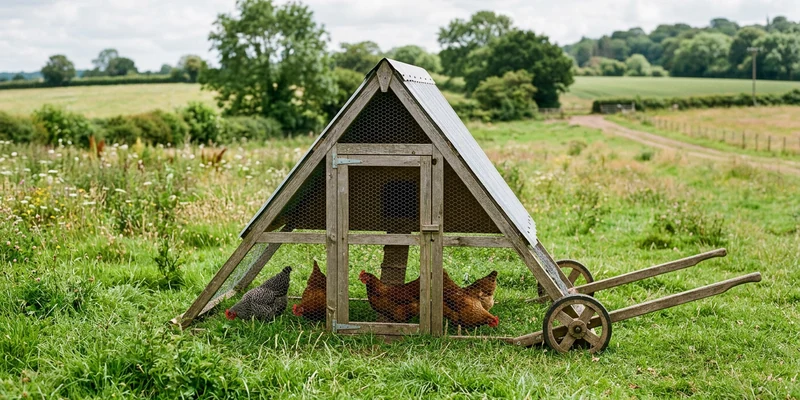
A chicken tractor solves a problem a stationary coop cannot: grass wears out. Leave a fixed run in one spot for a season and the ground underneath turns to bare dirt, mud when it rains, and a buildup of droppings with nowhere to go. A chicken tractor, sometimes sold as a mobile chicken coop or a chicken coop with wheels, is a lightweight, floorless coop and run combination designed to be moved regularly so the flock always has fresh ground and the yard gets a rest.
This guide covers how to size a chicken tractor to your flock, how often to move one, and the real tradeoffs against a stationary coop, since a tractor is not simply a smaller coop on wheels, it changes how you think about predator-proofing, weather protection, and daily routine.
Quick Answer
Is a chicken tractor right for your flock?
- Chicken tractors suit smaller flocks and yards with enough open ground to rotate across, generally sized around 2 to 4 sq ft per bird depending on how often it moves.
- Moving daily or every few days keeps grass from wearing out and spreads droppings naturally instead of concentrating them in one spot.
- Tractors trade some of a stationary coop’s insulation and storage for fresh ground and lower long-term predator pressure from digging animals.
- They generally suit moderate climates better than harsh winters, since a lightweight movable structure is harder to insulate heavily.
Chicken Tractor Sizing at a Glance
Sizing a tractor depends heavily on how often you plan to move it. A tractor moved daily can run smaller per bird than one left in place for several days at a time, since the ground has less time to get worn down or fouled between moves.
| Move frequency | General space per bird | Best suited for |
|---|---|---|
| Daily | Roughly 2 to 3 sq ft per bird | Small to medium flocks, keepers able to move it every morning |
| Every few days | Roughly 3 to 4 sq ft per bird | Flocks where daily moves are not realistic |
| Height | Roughly 6 ft at the center, tapering lower at the sides | Comfortable access for cleaning and egg collection |
| Materials | Lightweight frame, hardware cloth panels | A structure light enough to move without sacrificing predator protection |
A tractor sized for daily moves and a slightly larger one for a less frequent schedule can both work well; the mismatch to avoid is a tight footprint paired with an infrequent move schedule, since that combination wears out ground and stresses the flock fastest.
How a Chicken Tractor Differs From a Stationary Coop
A stationary coop, even one with an attached run, keeps birds on the same patch of ground indefinitely, which works fine with enough total space or a deep litter approach inside the run, but it does concentrate droppings and wear in one location over time. A chicken tractor spreads that impact across a rotation of ground, which is closer to how free-ranging poultry would naturally use a landscape.
The structural tradeoff is real, though. Tractors are floorless by design, built light enough to move by hand or with a small vehicle, which limits how much insulation, storage, and permanent equipment they can carry compared with a fixed coop. Our guide to chicken coop plans covers the stationary side of this decision in more depth if a tractor turns out not to fit your setup.
Sizing and Move Frequency: The Two Numbers That Matter Most
Space per bird and how often you actually move the tractor are more important to get right than any other design detail, including materials or wheel type. A commonly cited range is roughly 2 to 4 sq ft per bird, with the lower end reserved for tractors moved daily and the higher end for a less frequent schedule. Moving the tractor a short distance, often just several feet, each time it is relocated keeps fresh grass ahead of the flock without leaving so much bare, trampled ground behind that it takes a season to recover.
Be realistic about your own schedule before committing to a daily-move design. A tractor sized for daily rotation but only moved twice a week will wear out its ground almost as fast as a stationary run, just across a slightly larger area. If your routine is less predictable, size generously and move on the schedule you can actually keep.
Predator-Proofing a Structure That Moves
A tractor has one real advantage against digging predators: it does not stay in one place long enough for an animal to dig in from underneath before the whole structure relocates. That advantage disappears if the tractor sits still for extended stretches, so predator-proofing still matters on every panel. Hardware cloth on all sides and the top, not the thinner chicken wire many budget tractors ship with, remains the standard, and our guide comparing hardware cloth and chicken wire covers the mesh and gauge details that apply just as much to a moving structure as a fixed one.
Ground-level predators that can act quickly, rather than dig over time, are the bigger risk with a floorless design. A secure latch and full mesh coverage on all sides, including underneath if the frame sits high enough to leave a gap, closes that window.
A tractor still has to be shut at dusk, and that is the step most likely to be skipped on a wet evening. An automatic door handles it whether or not you make it out to the paddock.
Chicken Tractor Plans: DIY or Buy?
Chicken tractor plans are widely available for a reason: the design is simple enough that many keepers build their own from a frame of lumber or PVC, hardware cloth panels, and a set of wheels or skids on one end for dragging. A DIY build lets you size the tractor exactly to your flock and yard, and it is generally the lower-cost route if you already have basic tools.
A pre-built or kit tractor trades some of that customization for convenience and consistent construction quality, which matters if a DIY build is not realistic on your schedule. Either route, check the same fundamentals: mesh grade, a roof or cover that sheds rain, and a weight you can actually move alone if that is who will be doing the moving.
It is worth pricing a build against a finished structure before cutting anything, since hardware cloth and roofing add up quickly. Our coop guide gives a reference point for that comparison.
Common Mistakes With Chicken Tractors
- Sizing for daily moves but moving less often. The ground wears out almost as fast as a stationary run once the schedule slips.
- Using chicken wire instead of hardware cloth. A tractor’s mobility does not replace the need for a real predator barrier on every panel.
- Building it too heavy to move alone. A tractor that requires two people every time tends to get moved less often than planned.
- Skipping a roof or cover. Without weather protection, a movable run offers little shelter during a storm.
- Using a tractor through a harsh winter. Lightweight, floorless structures are harder to insulate and suit moderate climates better than extreme cold.
Frequently Asked Questions
How big should a chicken tractor be? A common range is roughly 2 to 4 sq ft per bird, with a smaller footprint suited to tractors moved daily and a larger one for a less frequent move schedule.
How often should you move a chicken tractor? Daily is ideal for keeping ground fresh, though every few days works if the tractor is sized generously enough for that schedule.
Is a chicken tractor better than a stationary coop? Neither is universally better. Tractors offer fresh ground and lower long-term predator pressure from digging animals, while stationary coops offer more insulation, storage, and structural durability.
Can a chicken tractor be used in winter? It is possible in moderate climates, but lightweight, floorless designs are harder to insulate heavily, so many keepers switch to a stationary coop for harsh winters.
What material is a chicken tractor usually made from? A lightweight frame, often wood or PVC, covered with hardware cloth panels rather than chicken wire, mounted on wheels or skids for moving.
Do chicken tractor plans work for any flock size? Plans scale reasonably well, but check that the sizing matches your actual flock and that you can move the finished structure yourself before committing to a specific design.
The Bottom Line
A chicken tractor trades some of a stationary coop’s insulation and storage for fresh ground and lower digging-predator pressure, and it works best for smaller flocks in moderate climates with a realistic move schedule. Size it to roughly 2 to 4 sq ft per bird depending on how often it will move, use hardware cloth rather than chicken wire on every panel, and build or buy something light enough that moving it actually happens as planned.