Last updated: August 16, 2026
Chicken wire looks like the obvious choice for a coop run. It is inexpensive, widely available, and it has “chicken” in the name. It is also, according to nearly every keeper who has lost birds to a determined predator, not the material that actually keeps a flock safe. Chicken wire is built to keep chickens in, not to keep raccoons, weasels, or dogs out, and the difference between the two jobs is where most predator losses start.
This guide compares hardware cloth and chicken wire directly: what each is actually built for, where chicken wire still has a legitimate place on a coop, and how to plan a run’s fencing so it stops the animals that are already testing it at night, whether or not you have found the gap yet.
Quick Answer
Hardware cloth or chicken wire, which should you use?
- Use hardware cloth, generally half inch mesh in sturdy wire, on every window, vent, and run panel a predator could reach.
- Save chicken wire for jobs where it is actually suited, such as dividing space inside a run, building a simple chicken fence around garden beds, or keeping birds off planted areas, not for perimeter security.
- Address the ground as carefully as the walls, since digging predators go under a fence line that stops at the surface.
- Check gauge as well as mesh size; thin wire can be pushed or chewed through even at a small opening.
Hardware Cloth vs. Chicken Wire at a Glance
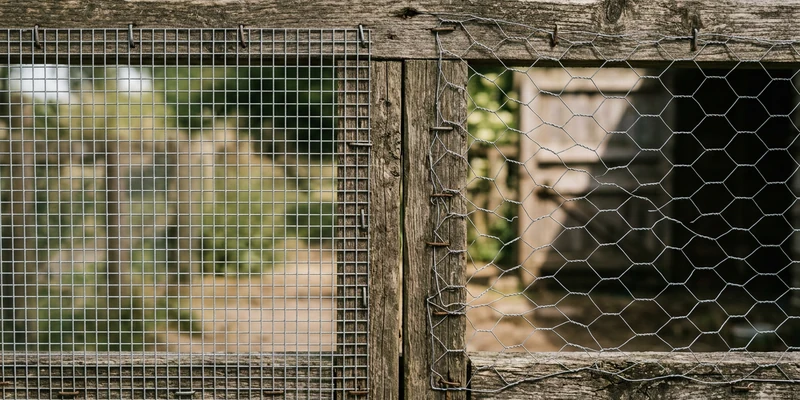
The two materials look similar from a distance and get confused constantly, but they solve different problems. This table is the fastest way to see where each one actually belongs on a coop and run.
| Feature | Chicken wire | Hardware cloth |
|---|---|---|
| What it is | Lightweight hexagonal mesh, thin gauge wire | Welded square mesh, heavier gauge wire |
| What it stops | Chickens moving in or out of an area | Raccoons, weasels, rats, and most digging or reaching predators |
| Typical mesh size | 1 inch openings, sometimes larger | Commonly half inch, sometimes a quarter inch near ground level or pop doors |
| Where it belongs | Garden barriers, interior dividers, keeping birds off beds | Windows, vents, run panels, and anywhere perimeter security matters |
| Ground-level use | Not recommended, easily pried or dug under | Buried edge or apron skirt to block digging animals |
Our guide on predator-proofing a coop and run covers how this fencing choice fits into the rest of a build.
Why Chicken Wire Fails Against Predators
Chicken wire is made from thin, twisted strands of wire woven into a hexagonal pattern, and it was designed to contain birds, not to resist an animal trying to get through it. A raccoon can reach through the gaps with its dexterous front paws, a dog can tear a panel apart with enough persistence, and a determined predator can simply push through worn or rusted sections that have weakened over a season or two outdoors.
None of this makes chicken wire useless. It still works well for dividing a run into sections, keeping birds out of a vegetable garden, or covering a temporary space where predator pressure is low. The mistake is treating it as the security layer on a permanent coop or run, which is where most of the loss reports involving chicken wire actually happen.
What Hardware Cloth Gets Right
Hardware cloth is a welded wire mesh, generally sold in half inch openings for general coop use, with a quarter inch mesh recommended for pop doors and any gap smaller than about two inches where mice or snakes could otherwise pass. The welded construction and heavier gauge wire, typically 19 gauge or thicker for predator-proofing, resist both pulling and chewing far better than woven chicken wire.
Half inch mesh blocks raccoons and most dogs effectively, though keepers in weasel country should note that adult weasels are stopped by half inch mesh while smaller juveniles can occasionally squeeze through, which is one reason some keepers step down to a quarter inch mesh in high pressure areas.
Cost and stiffness are the tradeoffs: hardware cloth is more expensive per foot than chicken wire and harder to bend around curves, but that stiffness is part of what makes it resist prying in the first place.
The Ground Is Where Most Fencing Plans Fail
A wall of hardware cloth does nothing if a predator can dig underneath it, and digging animals, including dogs, foxes, and some wild species, will go under a fence line that stops at the surface rather than testing the mesh itself. Two approaches address this: burying the base of the fence six to twelve inches into the ground, or laying an apron of hardware cloth flat on the surface extending twelve to eighteen inches outward from the fence line, then covering it with soil, mulch, or gravel so it stays in place.
The apron method generally requires less digging labor than a fully buried skirt and works on the same principle either way: a predator that hits solid wire while trying to dig down gives up before reaching the birds. In sandy or loose soil, extending the apron toward the longer end of that range is worth the extra material.
Building the Run: Panels, Posts, and a Top Cover
A run’s fencing is only as strong as its weakest connection point, so panels of hardware cloth should overlap at seams and be fastened with washers or fencing staples spaced closely enough that a raccoon cannot pry a gap open. Posts set firmly in the ground, rather than resting loosely against a frame, keep the whole structure from flexing under a predator testing it repeatedly over several nights.
Aerial predators like hawks are a separate risk that ground-level fencing does not address. A top cover, whether solid roofing, netting, or a run-spanning panel of hardware cloth, closes that gap. Our guide on chicken tractors covers how a fully enclosed, movable run handles both ground and overhead predator pressure differently than a fixed run does.
Common Mistakes When Fencing a Run
- Using chicken wire as the main perimeter barrier. It contains birds but does little to stop a predator that wants in.
- Stopping the fence at ground level. Digging predators exploit any gap where the fence meets the yard. Bury the edge or add an apron.
- Choosing thin gauge wire to save on cost. A lighter gauge is easier to pry or chew through, especially after a season of weathering.
- Skipping a top cover. Hawks and owls attack from above, which ground fencing alone cannot address.
- Letting mesh corrode or loosen without inspection. Check seams and staples periodically, since a small gap tends to become a larger one under repeated pressure.
Frequently Asked Questions
Is chicken wire ever safe to use on a coop? It works for low-risk jobs like interior dividers or garden barriers, but it is not recommended as the main predator barrier on a run or coop opening.
What size hardware cloth should I use for a chicken run? Half inch mesh is the common standard for general predator protection, with a quarter inch mesh recommended for pop doors and small gaps where mice or snakes might otherwise pass.
How deep should I bury hardware cloth around a run? A common range is six to twelve inches when burying the edge directly, or a flat apron extending twelve to eighteen inches outward from the fence line as an alternative to digging deep.
Does hardware cloth stop hawks and owls? Ground-level fencing does not address aerial predators. A top cover over the run, whether solid roofing or a spanning layer of mesh, is needed for overhead protection.
What wire gauge is strong enough to resist a raccoon? Look for roughly 19 gauge or thicker hardware cloth for perimeter security. Thinner wire is easier to pull apart or chew through over time.
Is hardware cloth worth the extra cost over chicken wire? For anywhere a predator could realistically reach, yes. The higher material cost is small compared with the cost of a coop breach.
The Bottom Line
Chicken wire keeps chickens where you put them. Hardware cloth is what actually keeps predators out, and the difference matters on every window, vent, and run panel a raccoon, weasel, or dog could reach. Choose a sturdy gauge, address the ground with a buried edge or apron, and add a top cover before assuming a run is secure.